FTSE Finish Line: June 15 — Peace Rally Reverses as BoE Vote Risk Moves Centre Stage
FTSE Finish Line: June 15 — Peace Rally Reverses as BoE Vote Risk Moves Centre Stage
London started the week with a relief bid, but the shine faded quickly. The FTSE 100 jumped to 10,569.50 in early trade after Iran and the U.S. reached an agreement to end the Middle East conflict and reopen the Strait of Hormuz. The market message was clean: peace is good for risk, but not equally good for every sector. The reopening of Hormuz crushed the oil risk premium, sending Brent down about 5.5% to $82.52. That eased inflation fears and supported cyclicals, miners and rate-sensitive names. But it also hit the FTSE’s heavy energy complex, with Shell down 4.4% and BP off 3.4%. Those two alone were enough to drag the index well off its early highs. Under the surface, however, the tape was stronger than the headline suggested. Miners were bid hard. Fresnillo surged 7.5%, Antofagasta rallied 6%, Endeavour Mining climbed 5.7%, Anglo American gained 3.2% and Rio Tinto added 1.5%. The move reflected a broader rotation into global cyclicals as geopolitical tail risk fell and investors reassessed commodity demand outside the oil complex. Industrials also had a strong session. Rolls-Royce rose 4.3%, Halma rebounded 4.2% after last week’s guidance-driven slump, and Weir advanced nearly 4%. Polar Capital Technology Trust, Mondi, Melrose, IAG, IMI, Howden Joinery, Smiths, Barratt Redrow, Lion Finance and Spirax all gained between 2% and 3.4%. The bid in IAG made sense with jet fuel prices sliding; lower oil is a direct margin tailwind for airlines. Financials were also supportive. Standard Chartered, Barclays, HSBC, NatWest and Prudential all moved higher, helped by firmer risk appetite and the prospect that the Bank of England will not be rushed into easing. Berkeley, F&C Investment Trust, InterContinental Hotels, Marks & Spencer and Bunzl also posted solid gains. The losers told the other side of the story. Alongside BP and Shell, defensive and yield-sensitive names softened. BT fell nearly 3%, while United Utilities, Vodafone, Centrica, BAE Systems, Severn Trent, Burberry, Airtel Africa, Scottish Mortgage and National Grid were also lower. Defence stocks gave back some geopolitical premium, utilities lagged as investors rotated into cyclicals, and telecoms remained under pressure.
The macro focus now shifts squarely to the Bank of England. No one expects a change in Bank Rate from 3.75% this week. The market-moving detail will be the vote split. Governor Bailey has effectively signalled that he is willing to tolerate inflation staying above target for longer if that avoids unnecessary damage to output and employment. That is the classic trade-off problem: an energy shock pushes inflation higher, while activity indicators soften. The economy has to absorb the cost one way or another — either through weaker growth and employment to force inflation down faster, or through a longer period of above-target inflation to protect demand. Bailey currently favours the second approach. Pill does not. He already voted for a hike in April, preferring to limit both the size and duration of the inflation overshoot. Greene now looks likely to join him after recent comments that emphasised pre-emptive action against inflation persistence. That points to a likely 7–2 vote to hold, with Pill and Greene dissenting for a 25bp hike. The risk is that the hawkish bloc grows. Mann is always difficult to pin down given her more activist reaction function, and Lombardelli has been quieter. A 6–3 hold would not shock the market if Mann joins the dissenters. That would still leave policy unchanged, but it would make the MPC look less comfortable with the inflation backdrop.The bigger tail risk is not the usual hawks. It is whether one of the previously dovish members jumps over Bailey and backs a hike. Taylor and Breeden do not look close to that point based on recent comments. Dhingra and Ramsden are the ones to watch later in the summer: both have acknowledged scenarios where tighter policy may be needed, even if this meeting likely comes too soon for them to break cover. That makes the July Monetary Policy Report a more dangerous event for rates than June. If inflation expectations stay high, CPI firms again and wage growth does not cool enough, the risk is that the Governor’s median position is challenged. In that scenario, the market would need to price not just “higher for longer,” but the possibility that a majority can form around another hike.
Finish Line: The FTSE 100’s peace rally was real but uneven. Lower oil lifted miners, airlines, industrials and financials, but it hammered Shell and BP, pulling the index back toward flat. The bigger story now is the BoE. A hold at 3.75% is almost locked in, but the vote split matters. 7–2 is the base case, 6–3 is plausible, and the true bearish rate risk is not this week — it is the chance that former doves start moving toward hikes before the July MPR.
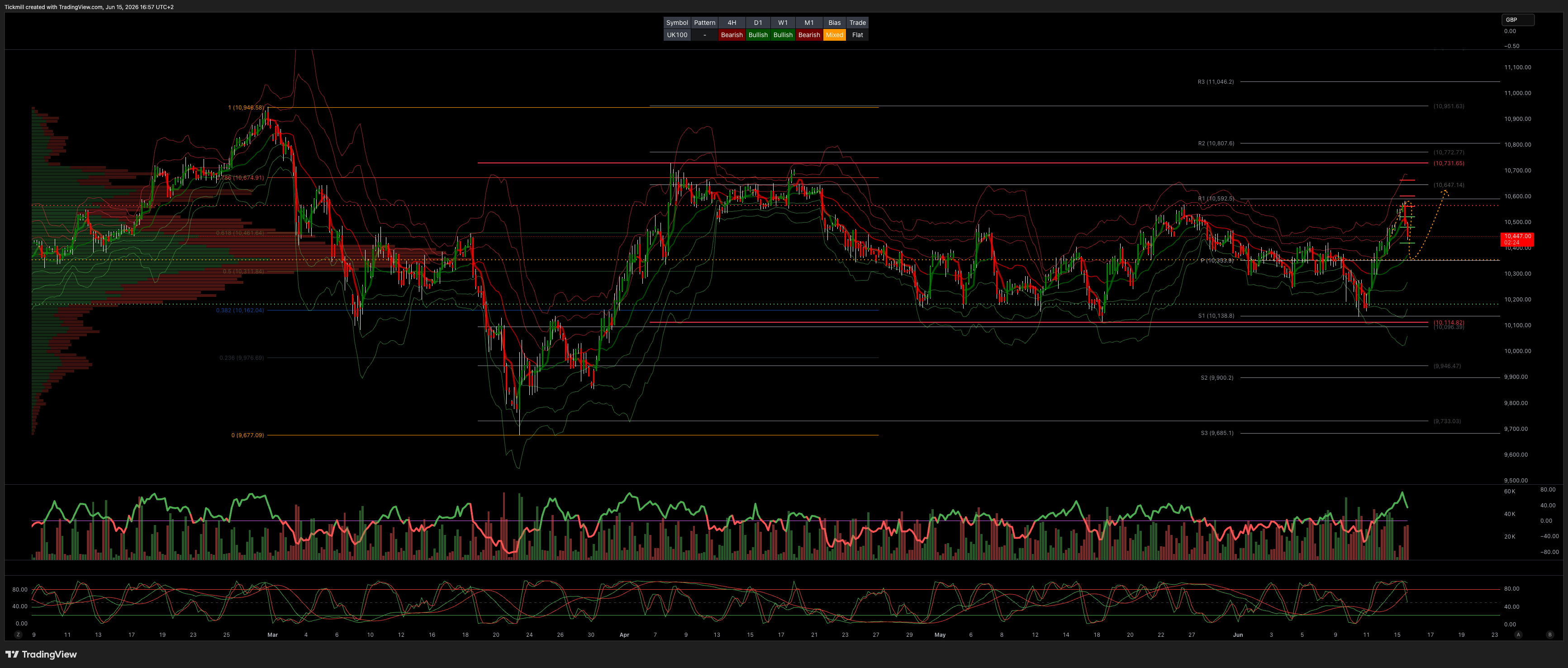
TECHNICAL & TRADE VIEW – FTSE100
Daily VWAP Bullish
Weekly VWAP Bullish
Above 10350 Target 11000
Below 10100 Target 9469
Disclaimer: The material provided is for information purposes only and should not be considered as investment advice. The views, information, or opinions expressed in the text belong solely to the author, and not to the author’s employer, organization, committee or other group or individual or company.
Past performance is not indicative of future results.
High Risk Warning: CFDs are complex instruments and come with a high risk of losing money rapidly due to leverage. 69% and 73% of retail investor accounts lose money when trading CFDs with Tickmill UK Ltd and Tickmill Europe Ltd respectively. You should consider whether you understand how CFDs work and whether you can afford to take the high risk of losing your money.
Futures and Options: Trading futures and options on margin carries a high degree of risk and may result in losses exceeding your initial investment. These products are not suitable for all investors. Ensure you fully understand the risks and take appropriate care to manage your risk.
Patrick has been involved in the financial markets for well over a decade as a self-educated professional trader and money manager. Flitting between the roles of market commentator, analyst and mentor, Patrick has improved the technical skills and psychological stance of literally hundreds of traders – coaching them to become savvy market operators!